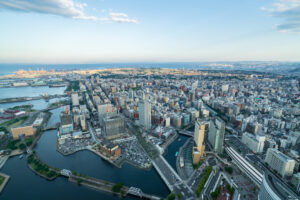
Yokohama City: A Global Business Gateway Combining Innovation, Livability, and Strategic Access
 kanri
kanriYokohama City, the capital of Kanagawa Prefecture and Japan’s second-largest city, stands as one of the country’s most internationally oriented business environments. Located immediately south of Tokyo, Yokohama offers companies direct access to the Greater Tokyo market while providing a more balanced, scalable, and livable urban setting. With its historic role as an international port city, Yokohama has long cultivated a culture of openness and innovation. Today, it is evolving into a comprehensive business hub that integrates advanced industries, global talent, and high-quality urban infrastructure.
For overseas companies, Yokohama presents a compelling value proposition: Tokyo-level connectivity with greater operational flexibility, strong institutional support, and a highly attractive living environment. This article explores why Yokohama continues to attract global investment and how it positions itself as a gateway for business expansion in Japan.
Strategic Location within the Greater Tokyo Area
Yokohama’s most immediate advantage is its strategic position within the Tokyo metropolitan area.
The city offers:
- Direct rail access to central Tokyo within 30 minutes
- Close proximity to Haneda Airport, enabling efficient international travel
- Seamless integration with Kanagawa’s industrial zones, including Kawasaki and surrounding areas
This allows companies to:
- Maintain close contact with headquarters and clients in Tokyo
- Access one of the world’s largest economic regions
- Operate in a location with more space and flexibility
Yokohama effectively serves as a gateway between Tokyo’s financial core and Kanagawa’s industrial base.
Global Connectivity and Accessibility
Yokohama’s infrastructure supports both domestic and international business operations.
Key features include:
- One of Japan’s largest international ports, facilitating global trade
- Extensive rail and road networks connecting major cities across Japan
- Efficient access to airports and logistics hubs
This level of connectivity enables companies to manage:
- International supply chains
- Regional distribution
- Cross-border business operations
For overseas firms, Yokohama provides a well-connected platform for both market entry and regional expansion.
A Culture of Innovation and International Orientation
Yokohama’s identity as an international city shapes its business environment.
The city promotes:
- Openness to foreign companies and global partnerships
- Cross-industry collaboration
- Support for new business models and emerging technologies
This culture is reflected in:
- A high concentration of foreign-affiliated companies
- Active collaboration between government, academia, and industry
- Initiatives that encourage innovation and entrepreneurship
Compared to more traditional business environments, Yokohama offers a more flexible and globally minded ecosystem, making it easier for overseas firms to integrate and operate.
Highly Skilled Workforce and Talent Ecosystem
Yokohama benefits from a deep and diverse talent pool.
Key strengths include:
- Access to professionals working across the Greater Tokyo area
- A high concentration of engineers, researchers, and technical specialists
- Strong links with universities and research institutions
This allows companies to:
- Recruit experienced professionals across multiple industries
- Build R&D and innovation teams
- Scale operations without severe talent shortages
For global firms, Yokohama offers a rare combination of talent availability and workforce stability.
Business Districts and Cost Competitiveness
Yokohama provides a range of business districts that support different operational needs.
These include:
- Modern waterfront developments designed for global companies
- Established commercial areas with strong infrastructure
- Flexible office spaces suitable for startups and growing firms
Compared to central Tokyo, Yokohama offers:
- Lower office rental costs
- More spacious and flexible layouts
- Opportunities for long-term expansion
This enables companies to optimize cost structures while maintaining proximity to key markets.
Business Support and Incentive Framework
Yokohama offers a structured support system for companies entering and expanding within the city.
Key elements include:
- Financial incentives for business establishment and expansion
- Support for innovation-driven and strategic industries
- Assistance for foreign companies navigating regulatory and administrative processes
The city emphasizes:
- Practical, execution-focused support
- Close coordination with companies throughout the setup process
- Long-term partnership rather than one-time assistance
For overseas firms, this reduces entry barriers and accelerates time-to-operation.
Quality of Life as a Competitive Advantage
Yokohama consistently ranks among Japan’s most livable cities, and this plays a critical role in business success.
The city offers:
- A waterfront urban environment with open spaces and modern amenities
- Shorter commuting times compared to Tokyo
- High-quality housing and international schools
- A vibrant cultural and dining scene
These factors support:
- Attraction of global talent
- Retention of skilled employees
- Smooth relocation of executives and their families
For companies, Yokohama’s livability translates directly into higher employee satisfaction and long-term organizational stability.
A Balanced Platform for Business and Lifestyle
Yokohama’s key strength lies in its balance.
It combines:
- Access to one of the world’s largest markets
- A strong industrial and innovation ecosystem
- Operational efficiency and cost advantages
- A high-quality living environment
This balance makes Yokohama particularly suitable for:
- Regional headquarters
- R&D and innovation centers
- Sales and marketing offices
- Back-office and support functions
Rather than specializing in a single role, Yokohama offers a multi-functional business platform.
Summary
Kanagawa Prefecture represents one of Japan’s most complete and practical business environments. By combining proximity to Tokyo, industrial depth, engineering talent, and operational flexibility, it offers a unique platform for companies seeking both immediate market access and long-term growth potential.
Rather than competing directly with Tokyo, Kanagawa enhances it — providing the space, cost structure, and industrial ecosystem that enable businesses to operate more efficiently and expand more effectively.
For overseas companies entering Japan, Kanagawa stands out as a strategic industrial core: connected, capable, and built for scalable success.
Feel free to contact us
MAY Planning provides advisory services on Japan market entry and Yokohama-based expansion strategy, including business district selection, cost optimization, and operational setup planning. We support companies in workforce planning and talent acquisition, office and facility establishment, government liaison and incentive coordination, and integration into Yokohama’s innovation ecosystem, enabling efficient and scalable business operations within the Greater Tokyo area.
References:
1)(N.d.). OPEN YOKOHAMA. https://businessyokohama.com/