
Japan’s Domestic AI Strategy and What It Means for Global AI Businesses
 kanri
kanriAs generative AI competition intensifies worldwide, governments are increasingly treating artificial intelligence as a strategic issue tied to economic competitiveness, industrial policy, and digital sovereignty. The rapid growth of large language models and AI infrastructure has created a new phase of global technological competition involving both private companies and national governments.
Japan is responding by accelerating efforts to strengthen its domestic AI ecosystem through initiatives such as 「GENIAC」, support for AI startups, and collaboration between domestic enterprises and global technology firms. For overseas AI companies, understanding these developments is becoming increasingly important for identifying partnership opportunities, market-entry strategies, and future business demand.
This article examines Japan’s evolving domestic AI strategy, the role of ecosystem initiatives such as GENIAC, and what these developments may mean for global AI businesses seeking to engage with the Japanese market.
Why Japan Is Investing More Aggressively in AI
Japan’s recent acceleration in AI-related policy and industrial support reflects several overlapping concerns.
One major factor is the growing global concentration of AI capabilities among a relatively small number of overseas technology giants. Large-scale AI development increasingly depends on access to advanced semiconductors, massive computational resources, cloud infrastructure, and large proprietary datasets. As generative AI becomes more deeply integrated into business operations and national digital infrastructure, concerns regarding technological dependence are also increasing.
For Japan, this issue extends beyond simple market competition.
AI is now closely connected to:
- economic security
- industrial competitiveness
- productivity growth
- data governance
- digital infrastructure resilience
- workforce transformation
As a result, Japanese policymakers are increasingly viewing AI as a strategic technology area that may influence the country’s long-term economic position.
Another important factor is demographic pressure. Japan’s aging society and shrinking labor force continue to create severe workforce shortages across multiple industries. AI is therefore being positioned not only as a growth technology, but also as a tool capable of supporting productivity improvements and operational sustainability.
At the same time, Japan faces pressure to strengthen its broader digital transformation environment. Compared with some global technology leaders, parts of Japan’s corporate sector still rely heavily on legacy systems, fragmented workflows, and labor-intensive operational structures. Policymakers increasingly recognize that AI development and digital transformation are closely interconnected.
This broader context helps explain why the Japanese government is supporting not only AI research itself, but also:
- startup ecosystem development
- enterprise AI implementation
- cloud infrastructure expansion
- advanced semiconductor investment
- public-private collaboration
- workforce upskilling
Rather than focusing solely on cutting-edge model development, Japan’s strategy is gradually evolving into a broader effort to build a sustainable AI ecosystem.
Understanding 「GENIAC」 and Japan’s AI Ecosystem Strategy
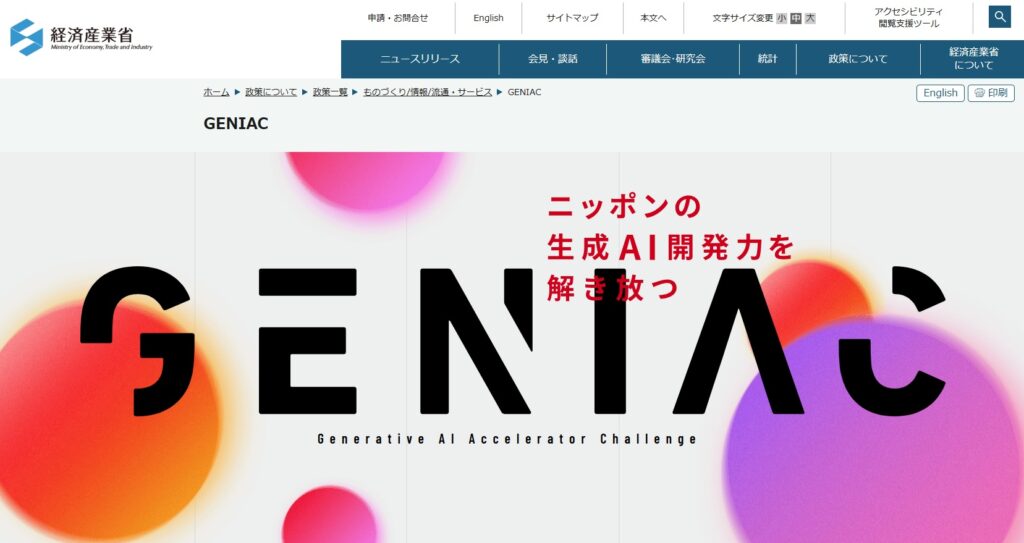
One of the most important recent developments in Japan’s AI strategy is the launch of 「GENIAC」 by the METI (経済産業省).
GENIAC was established to strengthen Japan’s domestic generative AI development ecosystem by supporting startups and companies engaged in foundation model research and AI-related innovation. The initiative reflects growing recognition that access to computational resources has become one of the largest barriers facing AI developers worldwide.
Training and operating advanced generative AI models requires enormous computing capacity, including large-scale GPU infrastructure that can be prohibitively expensive for startups and emerging companies. By supporting access to computational resources and development environments, GENIAC aims to reduce these barriers and encourage domestic AI innovation.
Importantly, the initiative is not limited solely to pure research activity. Its broader objectives also include:
- accelerating commercialization
- strengthening collaboration between startups and enterprises
- supporting practical implementation
- encouraging ecosystem expansion
- fostering globally competitive AI businesses
This reflects a significant shift in Japan’s AI policy direction. Rather than relying entirely on overseas AI platforms, Japan is increasingly attempting to cultivate:
- domestic AI capabilities
- Japanese-language model development
- specialized industry applications
- enterprise AI integration expertise
The strategy also recognizes that Japan may not necessarily compete directly with global hyperscalers on scale alone. Instead, opportunities may emerge through:
- industry specialization
- operational integration
- enterprise-focused AI
- manufacturing-related AI applications
- Japanese-language optimization
- highly reliable enterprise deployment models
This approach aligns closely with the structure of Japan’s economy, which remains heavily centered around large industrial enterprises, advanced manufacturing, and long-term B2B business relationships.
The Growing Role of Japanese AI Startups
Alongside government initiatives, Japan’s domestic AI startup ecosystem is becoming increasingly active.
Companies such as Exawizards, Preferred Networks, Sakana AI, and other emerging firms are contributing to the expansion of Japan’s AI ecosystem through partnerships, enterprise solutions, and research initiatives.
Many Japanese AI startups are focusing less on consumer-facing AI products and more on enterprise implementation, workflow optimization, and industry-specific solutions. This differs somewhat from portions of the global AI market that prioritize large-scale consumer platform expansion.
Several structural factors influence this trend.
First, Japan’s enterprise market places strong emphasis on reliability, operational continuity, and long-term vendor relationships. AI providers capable of integrating into existing enterprise workflows may therefore possess advantages over purely experimental or consumer-oriented platforms.
Second, Japanese enterprises frequently require highly customized operational adaptation. As a result, startups that understand industry-specific workflows and Japanese business operations may be particularly well positioned.
Third, collaboration between startups and large enterprises is becoming increasingly important. In Japan, partnerships with major corporations often play a critical role in scaling enterprise AI adoption. Telecommunications companies, manufacturing firms, financial institutions, and IT integrators are all becoming increasingly involved in AI-related collaboration. For example, partnerships involving companies such as Exawizards and major enterprise groups demonstrate how AI implementation in Japan is frequently tied to broader enterprise transformation initiatives rather than isolated software deployment.
This ecosystem structure may create opportunities for both domestic and overseas AI providers capable of participating in collaborative implementation models.
Why Japan Still Needs External AI Expertise
Despite increasing domestic investment, Japan’s AI ecosystem still faces multiple structural limitations. These limitations may create important opportunities for overseas AI businesses and international technology partnerships.
Computational Infrastructure Constraints
Like many countries, Japan faces challenges related to advanced GPU access, cloud-scale AI infrastructure, and semiconductor supply limitations.
Large-scale generative AI development requires substantial capital investment and computational resources. While government initiatives are expanding support capacity, competition for advanced infrastructure remains intense globally.
As a result, partnerships involving cloud infrastructure, AI optimization, and enterprise deployment expertise may continue to grow in importance.
Enterprise Implementation Experience
Many Japanese enterprises remain relatively early in their practical AI implementation journey. Although awareness of generative AI has increased rapidly, organizations often still require support in areas such as:
- workflow integration
- governance frameworks
- deployment planning
- operational redesign
- employee training
- security management
- multilingual implementation
This creates opportunities for companies capable of providing practical implementation support rather than standalone software products alone.
Global AI Talent Competition
AI talent shortages remain a significant issue internationally, and Japan is also affected by increasing competition for engineers, researchers, and implementation specialists.
For many organizations, the challenge is not only building AI systems, but also securing personnel capable of operating and integrating them effectively. This situation may increase demand for:
- external consulting support
- strategic partnerships
- cross-border collaboration
- specialized implementation providers
Localization and Enterprise Adaptation
As discussed in the previous article of this series, localization remains one of the most important characteristics of Japan’s AI market. Many overseas AI systems require adaptation for:
- Japanese-language operations
- formal business communication
- approval-heavy workflows
- enterprise reporting structures
- local compliance expectations
- customer support requirements
This creates substantial demand for localization expertise and operational integration support.
Partnership Opportunities for Overseas AI Companies
Japan’s AI market may therefore offer opportunities not only for direct product expansion, but also for collaborative ecosystem participation. In many cases, partnership-oriented approaches may be more effective than standalone market entry.
Potential partnership opportunities include:
- collaboration with Japanese system integrators
- enterprise implementation partnerships
- localization support arrangements
- industry-specific AI solution development
- manufacturing AI collaboration
- multilingual AI deployment support
- governance and compliance consulting
- AI workforce training initiatives
Organizations such as JETRO are also increasingly active in supporting international business collaboration and foreign investment within Japan’s technology ecosystem.
For overseas companies, one important strategic consideration is that Japanese enterprises frequently prioritize long-term operational trust over rapid procurement speed. Building relationships, demonstrating reliability, and providing localized support may therefore play major roles in successful market entry.
The Challenges of Entering Japan’s AI Market
Although opportunities are expanding, entering Japan’s AI market remains far from simple. Foreign companies often underestimate the operational complexity of Japanese enterprise environments. Some of the most common challenges include:
- long enterprise sales cycles
- highly detailed procurement evaluation
- complex internal approval processes
- extensive localization expectations
- customer support quality requirements
- documentation adaptation needs
- relationship-oriented business culture
In many cases, even technically strong AI solutions may struggle if implementation support and operational alignment are insufficient. This is particularly important in sectors involving:
- sensitive enterprise data
- regulated industries
- operational continuity requirements
- customer-facing communication
- mission-critical workflows
As a result, companies capable of combining technological capability with localization and operational adaptation may possess significant competitive advantages.
Japan’s AI Strategy Is Becoming More International
An important aspect of Japan’s evolving AI ecosystem is that it is becoming increasingly international rather than purely domestic.
While Japan is clearly attempting to strengthen domestic AI capability, policymakers and enterprises also recognize that international collaboration remains essential. This is visible through:
- partnerships between Japanese enterprises and overseas AI firms
- foreign investment activity
- international startup collaboration
- cloud infrastructure partnerships
- cross-border research cooperation
Rather than attempting complete technological isolation, Japan appears to be pursuing a hybrid strategy – strengthening domestic capabilities while remaining integrated within the global AI ecosystem.
This approach may create particularly strong opportunities for companies capable of acting as bridges between global AI innovation and Japanese enterprise implementation needs.
Business Implications for Global AI Companies
Several important implications are emerging from Japan’s evolving AI strategy. For overseas AI providers and technology companies, Japan increasingly represents:
- a long-term enterprise AI market
- a localization-intensive environment
- a partnership-driven ecosystem
- a growing implementation opportunity market
At the same time, success may depend heavily on:
- operational adaptation
- Japanese-language support
- governance alignment
- local relationship development
- enterprise integration capability
Rather than viewing Japan simply as a direct software sales destination, companies may achieve stronger results by approaching the market through collaboration, implementation partnerships, and long-term ecosystem participation.
Summary
Japan’s domestic AI strategy is evolving beyond simple technology development into a broader effort to strengthen industrial competitiveness, digital infrastructure, and enterprise transformation capability.
Initiatives such as GENIAC demonstrate that Japan is increasingly serious about building sustainable domestic AI capacity while encouraging commercialization and ecosystem expansion. At the same time, the country’s AI market continues to face substantial implementation, infrastructure, and localization challenges.
This combination is creating a unique environment where domestic development and international collaboration are advancing simultaneously.
For global AI businesses, Japan may therefore represent not only a technology market, but also a long-term partnership ecosystem requiring localization, operational understanding, and strategic adaptation.
As Japan’s AI transition accelerates, companies capable of bridging global AI innovation with Japanese enterprise needs may find substantial opportunities in the years ahead.
Feel free to contact us
MAY Planning provides advisory services on Japan AI market-entry and AI workflow integration. We also offer support on Japanese business partnership development, AI vendor matchmaking and partnership coordination, AI solution localization for Japanese enterprises and cross-border technology collaboration.
References:
1)令和7年版 情報通信白書の概要 企業におけるAI利用の現状. (n.d.). 総務省. https://www.soumu.go.jp/johotsusintokei/whitepaper/ja/r07/html/nd112220.html
2)令和7年版 情報通信白書の概要 日本のAI開発・事業展開の動向. (n.d.). 総務省. https://www.soumu.go.jp/johotsusintokei/whitepaper/ja/r07/html/nd112130.html
3)GENIAC. (n.d.). 経済産業省. https://www.meti.go.jp/policy/mono_info_service/geniac/index.html
4)【2025年最新】日本のAI企業26選!提供サービスや事例を紹介. (2025, November 14). EXAWIZARDS. https://exawizards.com/column/article/ai/japanese-ai-companies/
5)木内翔大. (2026, June 15). 【2026年最新】日本の生成AI企業18社!大手からベンチャーまで紹介. SHIFT AI TIMES. https://shift-ai.co.jp/blog/3069/
6)米オープンAIが日本法人を開設. (2024, April 19). JETRO. https://www.jetro.go.jp/biznews/2024/04/b0fc62a3e6d46896.html
7)AI自動生成ソリューションプラットフォームを開発・提供する米国企業AI Dynamicsが東京都に日本法人を設立. (2021, July 15). JETRO. https://www.jetro.go.jp/biznews/2024/04/b0fc62a3e6d46896.html
8)医療人工知能(AI)専門企業AITRICS、東京都に事務所を設立. (2025, November 20). JETRO. https://www.jetro.go.jp/invest/newsroom/2025/c7e8539856cd8d58.html
9)AI開発支援のワークフローを通じてデータ活用、AI導入、ビジネス最適化ソリューションを提供するSOLAZU Holdingが、神奈川県横浜市に日本法人を設立. (2025, October 22). JETRO. https://www.jetro.go.jp/invest/newsroom/2025/6939e35f2e9e1abf.html