
The Real Demand for AI Solutions in Japanese Workplaces
 kanri
kanriWhile discussions surrounding artificial intelligence often focus on breakthrough technologies and global competition, the reality inside many Japanese workplaces is far more practical. Most organizations are not adopting AI simply because it is innovative. They are looking for solutions to pressing business challenges. Japan’s shrinking workforce, persistent labor shortages, and growing pressure to improve productivity are pushing companies to rethink how work gets done. As a result, AI is increasingly viewed as a tool for addressing operational inefficiencies rather than a vehicle for disruptive transformation.
The AI solutions attracting attention in Japan tend to focus on improving workflows, reducing administrative burdens, and supporting employees in their daily tasks. For technology providers and overseas businesses, understanding these practical needs is essential. Success often depends less on technical sophistication and more on the ability to solve specific workplace problems within existing business environments.
This article explores the growing demand for AI solutions in Japanese workplaces, the operational challenges driving adoption, and the factors that determine whether AI projects ultimately succeed or fail.
Labor Shortages Are Becoming a Long-Term Business Challenge
Japan’s labor market has been under pressure for years, but demographic trends are making the challenge increasingly difficult to ignore. The country’s declining birthrate and aging population continue to reduce the size of the available workforce. As experienced employees retire, many organizations struggle to recruit replacements with comparable skills and institutional knowledge. The impact extends far beyond a handful of industries:
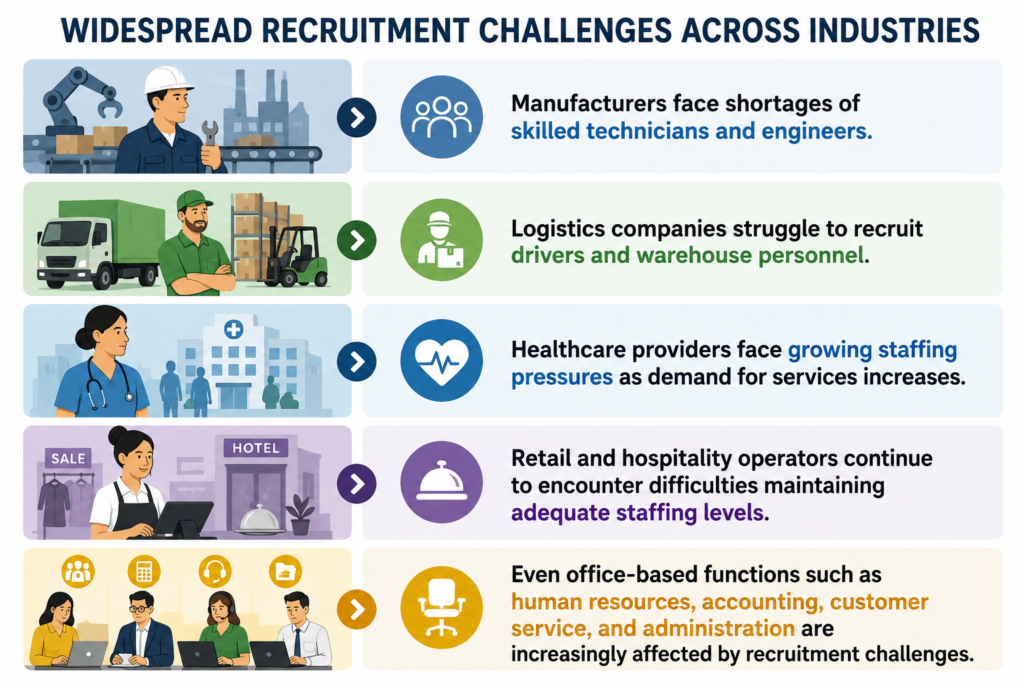
For many organizations, simply hiring more people is no longer a sustainable solution. As a result, management teams are increasingly evaluating how technology can help employees accomplish more with limited resources.
This is one of the most important drivers behind Japan’s growing interest in AI.
Unlike some markets where AI adoption is primarily driven by innovation objectives, many Japanese companies view AI as a tool for operational sustainability. The goal is not necessarily workforce replacement. Instead, the focus is often on helping existing employees manage increasing workloads more effectively.
What Japanese Companies Actually Want From AI
Although public discussions often focus on advanced AI capabilities, enterprise demand in Japan is frequently centered around relatively practical use cases. Many organizations are less interested in experimental applications and more interested in solving everyday operational problems.
Several categories consistently emerge as areas of strong interest.
Document Creation and Summarization
Japanese companies generate enormous volumes of documentation, including:
- meeting minutes
- internal reports
- proposals
- customer correspondence
- compliance documentation
- operational manuals
- project updates
Employees often spend substantial portions of their workday creating, reviewing, and revising documents. Generative AI can significantly reduce the time required for these activities by assisting with drafting, summarization, editing, and information extraction.
For organizations facing resource constraints, even modest productivity gains across large employee populations can produce substantial benefits.
Internal Knowledge Management
Knowledge management represents another major challenge. Many organizations possess decades of accumulated information stored across:
- internal databases
- file servers
- emails
- paper documents
- departmental systems
Finding the right information can be surprisingly time-consuming. AI-powered search and knowledge management systems are increasingly attracting attention because they allow employees to retrieve information more efficiently and reduce dependency on individual subject matter experts. This issue is particularly important as experienced workers retire and organizations seek ways to preserve institutional knowledge.
Customer Service and Support Operations
Customer service functions are among the most actively explored AI implementation areas in Japan. Organizations are evaluating AI for:
- customer inquiry handling
- chatbot deployment
- response drafting
- multilingual support
- call center assistance
- FAQ generation
Importantly, many companies do not intend to eliminate human customer support personnel.
Instead, AI is frequently viewed as a tool that enables support teams to respond more quickly, handle larger inquiry volumes, and focus on higher-value interactions.
Translation and Multilingual Communication
As Japanese companies expand internationally and foreign businesses increase their presence in Japan, multilingual communication requirements continue to grow. Organizations increasingly require support for:
- English-Japanese communication
- multilingual documentation
- overseas customer support
- international recruitment
- global project collaboration
AI-powered translation and communication assistance tools are therefore attracting significant attention, particularly among organizations that lack large dedicated translation teams.
Software Development Support
The software sector is also experiencing growing interest in AI-assisted development tools. Potential applications include:
- code generation
- debugging support
- documentation creation
- test case generation
- knowledge retrieval
Although adoption levels vary, many organizations are beginning to explore how AI can improve developer productivity without compromising quality or security standards.
Why Many AI Pilot Projects Fail
Despite increasing interest, not every AI initiative delivers successful outcomes. In fact, one of the most important realities of Japan’s AI market is that implementation challenges often prove more difficult than technology selection. Many organizations successfully launch pilot projects but struggle to achieve sustainable operational deployment. There are several common factors leading to this problem:
Unclear Business Objectives
Some organizations adopt AI because competitors are doing so or because senior leadership believes the technology is strategically important. However, projects frequently encounter difficulties when specific business objectives are poorly defined. Successful implementations typically begin with questions such as:
- Which operational process needs improvement?
- What productivity gains are expected?
- How will success be measured?
- Which teams will be responsible?
Without clear answers, pilot projects often fail to move beyond experimentation.
Lack of Organizational Ownership
AI initiatives frequently span multiple departments. Potential stakeholders include:
- IT
- operations
- HR
- legal
- compliance
- business units
When ownership remains unclear, implementation momentum can stall. Many organizations underestimate the amount of coordination required to deploy AI successfully across enterprise environments.
Employee Resistance
Concerns regarding job displacement remain common. Employees may worry that AI will:
- reduce job security
- alter responsibilities
- increase monitoring
- diminish professional value
Organizations that fail to address these concerns often encounter adoption resistance. In practice, successful implementations usually emphasize employee support rather than workforce replacement.
Security and Governance Concerns
In many cases, governance remains a major issue. Organizations frequently hesitate to expand AI usage due to concerns involving:
- confidential information
- data leakage
- regulatory compliance
- intellectual property
- model reliability
Many companies therefore spend considerable time developing internal policies before permitting broader AI deployment.
Localization Is Often the Difference Between Success and Failure
One of the most underestimated aspects of Japan’s AI market is localization.
Many overseas providers assume that translating interfaces into Japanese is sufficient. In reality, enterprise adoption often requires much deeper adaptation.
Japanese organizations frequently expect AI solutions to align with:
- formal business communication styles
- industry-specific terminology
- internal approval workflows
- reporting requirements
- documentation standards
- customer support expectations
This is particularly important in customer-facing environments where communication quality directly affects brand perception.
A technically capable solution may still encounter adoption challenges if it does not fit naturally into existing operational structures.
Therefore, localization should be viewed not as a marketing activity but as a core implementation requirement.
Emerging Enterprise AI Procurement Trends
As AI adoption matures, several procurement trends are becoming increasingly visible across Japanese enterprises.
Preference for Trusted Providers
Organizations often prioritize reliability and long-term support over aggressive innovation claims.
Factors such as:
- vendor reputation
- support capability
- implementation experience
- security controls
can strongly influence purchasing decisions.
Growing Demand for Industry-Specific Solutions
Generic AI tools remain useful, but many enterprises increasingly seek solutions tailored to their operational environments. Examples include:
- manufacturing AI
- healthcare AI
- HR AI
- financial services AI
- logistics AI
Industry-specific expertise is becoming an important competitive differentiator.
Increased Focus on Governance
Organizations are paying closer attention to:
- AI usage policies
- risk management
- compliance frameworks
- employee training
Vendors capable of supporting governance requirements may possess significant advantages.
Interest in Hybrid Deployment Models
Many companies remain cautious about placing sensitive information into fully public AI environments. As a result, interest is growing in:
- private AI environments
- enterprise-specific deployments
- hybrid cloud architectures
- controlled internal AI platforms
This trend may create opportunities for vendors specializing in secure enterprise deployments.
Business Implications for AI Providers
Several important lessons emerge from Japan’s workplace AI demand landscape.
For AI providers considering the Japanese market:
- Productivity improvement often matters more than technological novelty.
- Practical operational use cases generally receive stronger enterprise interest than experimental applications.
- Localization extends far beyond just language translation.
- Governance and security considerations significantly influence purchasing decisions.
- Industry-specific expertise can provide meaningful competitive advantages.
- Successful deployment frequently requires consulting, integration, and change-management support in addition to software products.
Organizations that understand these realities are likely to be better positioned to address Japan’s growing AI implementation needs.
Summary
The demand for AI solutions in Japanese workplaces is no longer driven solely by curiosity about emerging technologies. Increasingly, it is being driven by operational necessity.
Labor shortages, productivity pressures, workforce transformation, and digital modernization challenges are creating conditions where AI can deliver tangible business value across multiple industries.
At the same time, successful implementation requires far more than technological capability alone. Organizations must address governance concerns, employee adoption, workflow integration, and localization requirements before AI can achieve meaningful operational impact.
For AI solution providers, this presents both a challenge and an opportunity. The Japanese market is not necessarily seeking the most advanced AI technologies available. Instead, it is seeking solutions that can solve real workplace problems while fitting within the realities of Japanese business operations.
Those capable of delivering that combination may find significant opportunities as Japan’s AI adoption journey continues to accelerate.
Feel free to contact us
MAY Planning provides advisory services on Japan AI market-entry and AI workflow integration. We also offer support on Japanese business partnership development, AI vendor matchmaking and partnership coordination, AI solution localization for Japanese enterprises and cross-border technology collaboration.
References:
1)令和7年版 情報通信白書の概要 企業におけるAI利用の現状. (n.d.). 総務省. https://www.soumu.go.jp/johotsusintokei/whitepaper/ja/r07/html/nd112220.html
2)令和7年版 情報通信白書の概要 日本のAI開発・事業展開の動向. (n.d.). 総務省. https://www.soumu.go.jp/johotsusintokei/whitepaper/ja/r07/html/nd112130.html
3)GENIAC. (n.d.). 経済産業省. https://www.meti.go.jp/policy/mono_info_service/geniac/index.html
4)【2025年最新】日本のAI企業26選!提供サービスや事例を紹介. (2025, November 14). EXAWIZARDS. https://exawizards.com/column/article/ai/japanese-ai-companies/
5)木内翔大. (2026, June 15). 【2026年最新】日本の生成AI企業18社!大手からベンチャーまで紹介. SHIFT AI TIMES. https://shift-ai.co.jp/blog/3069/
6)米オープンAIが日本法人を開設. (2024, April 19). JETRO. https://www.jetro.go.jp/biznews/2024/04/b0fc62a3e6d46896.html
7)AI自動生成ソリューションプラットフォームを開発・提供する米国企業AI Dynamicsが東京都に日本法人を設立. (2021, July 15). JETRO. https://www.jetro.go.jp/biznews/2024/04/b0fc62a3e6d46896.html
8)医療人工知能(AI)専門企業AITRICS、東京都に事務所を設立. (2025, November 20). JETRO. https://www.jetro.go.jp/invest/newsroom/2025/c7e8539856cd8d58.html
9)AI開発支援のワークフローを通じてデータ活用、AI導入、ビジネス最適化ソリューションを提供するSOLAZU Holdingが、神奈川県横浜市に日本法人を設立. (2025, October 22). JETRO. https://www.jetro.go.jp/invest/newsroom/2025/6939e35f2e9e1abf.html