
Overseas Expansion × Digital Transformation × Cost Management: What Singapore’s Latest Business Survey Reveals About Sustainable Growth
 kanri
kanriBusinesses today are operating in an environment that is more uncertain than ever before. Rising costs, slowing demand, and increasing challenges in attracting and retaining talent are placing pressure on organizations simultaneously, making strategic decision-making increasingly complex. In particular, companies are facing mounting difficulties in managing cost structures heavily influenced by external factors such as rent and logistics expenses, while also being required to rethink traditional recruitment and workforce retention strategies. As a result, conventional approaches are becoming less effective in addressing these evolving challenges.
This article examines the latest survey findings on Singapore’s business landscape, highlighting the realities companies face, the structural challenges affecting different sectors, and the practical measures organizations can take to navigate uncertainty while positioning themselves for future growth opportunities.
Overall Business Sentiment: A More Cautious Corporate Outlook
The latest survey indicates that business sentiment among Singapore companies remains cautious. The Business Sentiment Index (BSI) declined to 52.2 compared with the previous quarter. While a BSI above 50 still indicates expansion, the margin remains relatively modest, suggesting that many businesses are adopting a wait-and-see approach amid uncertain market conditions.
Profitability Expectations over the next six months fell to 48.5, below the benchmark level of 50. Ongoing uncertainty in demand and continued cost pressures are limiting expectations for near-term profit growth. These concerns are not limited to small and medium-sized enterprises (SMEs); large corporations are facing similar challenges.
Against this backdrop, businesses are becoming more selective about investments and workforce expansion. At the same time, improving operational efficiency and restructuring revenue streams have become increasingly important strategic priorities.
Profitability and Sentiment Across Industries
Business sentiment varies significantly by sector. Financial services, insurance, and professional services continue to demonstrate relatively strong confidence, while retail, hospitality, and IT-related services remain under greater pressure. For retail and hospitality businesses in particular, slowing demand combined with fluctuating cost structures has made short-term profitability a key concern.
The financial and insurance sectors continue to maintain comparatively strong profitability expectations and appear more resilient to external economic volatility. Nevertheless, these industries are not immune to rising costs. Long-term competitiveness will still depend on improving operational efficiency and managing expenses effectively.
As a result, companies must develop strategies that reflect both sector-specific challenges and broader economic conditions. Industries that experience greater demand fluctuations will particularly benefit from adopting more flexible operating models.
Key Drivers of Rising Costs: Labor, Rent, and Logistics
According to the survey, labor costs, rental expenses, and logistics costs remain the primary contributors to rising business expenditures.
Increasing rental costs have become a major burden, especially for SMEs operating in urban and commercial districts. Many businesses are experiencing significant cost increases when renewing lease agreements. Logistics costs also continue to rise, with ongoing changes in global supply chains directly affecting day-to-day business operations.
While the degree of impact varies depending on industry and company size, these cost factors collectively place pressure on profit margins. The survey also suggests that SMEs tend to be more sensitive to fluctuations in utility expenses, while larger enterprises are more affected by changes in raw material costs.
Cost Management Measures Already Implemented
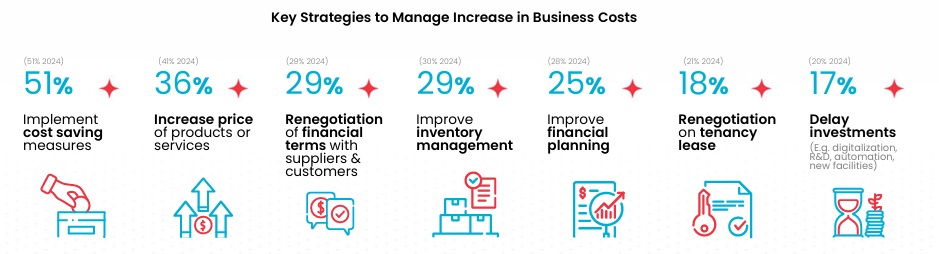
To address rising costs, companies have adopted a variety of measures. The most common responses include cost reduction initiatives (51%), price increases (36%), inventory optimization, and renegotiation of procurement terms.
Cost reduction remains the most widely adopted strategy, often involving office space consolidation, process improvements, and delays in capital expenditures. Although some companies have increased prices for products and services, they must carefully consider potential impacts on customer demand and sales volumes.
Inventory optimization and supplier diversification are viewed as particularly effective medium-term strategies. Reassessing supply sources and updating contractual arrangements can help reduce exposure to logistics disruptions and supply chain volatility.
Talent Management, Digital Transformation, and International Expansion
Workforce Trends: Salary Adjustments and Employee Retention
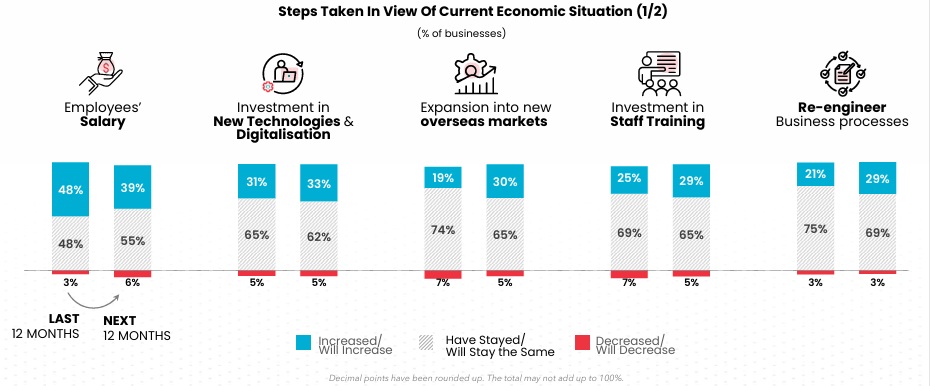
Many businesses intend to increase employee salaries over the next twelve months as part of broader talent retention and workforce stability efforts. Intensifying competition for skilled workers continues to drive these decisions.
Although investment in employee training and development has declined compared with the previous year, skills development remains a critical long-term competitiveness factor. Organizations are increasingly seeking training programs that deliver measurable returns on investment while enhancing workforce capabilities.
Looking ahead, companies are expected to place greater emphasis on upskilling existing employees and redesigning workflows to improve productivity and operational efficiency.
Continued Commitment to Digitalization and Global Growth
At the same time, businesses continue to prioritize digital transformation initiatives. Key focus areas include automating business processes, adopting digital tools, and strengthening online sales channels.
Interest in overseas expansion also remains strong. Many organizations are exploring new markets and international partnerships as part of their growth strategies. However, companies are approaching expansion cautiously, favoring phased investments and gradual market entry rather than large-scale commitments.
Internally, organizations are also reviewing workforce allocation and operational structures. These efforts are aimed at improving both productivity and cost efficiency through organizational transformation.
Corporate Priorities: Growth, Cash Flow Stability, and Cost Control
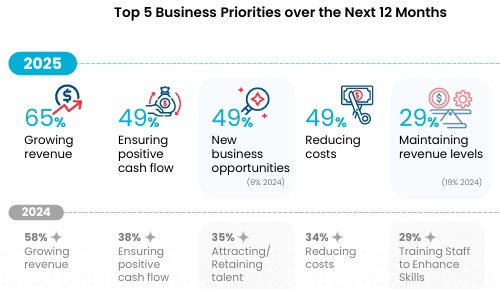
Over the next twelve months, companies identify revenue growth, cash flow stability, and cost management as their top priorities.
To drive growth, businesses are focusing on entering new markets, enhancing products and services, and redesigning sales channels. International expansion continues to attract significant interest, with many organizations testing new markets through pilot programs and limited initial investments.
Meanwhile, maintaining healthy cash flow has become essential in an unpredictable business environment. Companies are strengthening working capital management and liquidity planning to ensure financial resilience. Together with cost reduction efforts, these measures are viewed as critical to sustaining short-term profitability.
Cybersecurity: An Increasingly Critical Business Concern
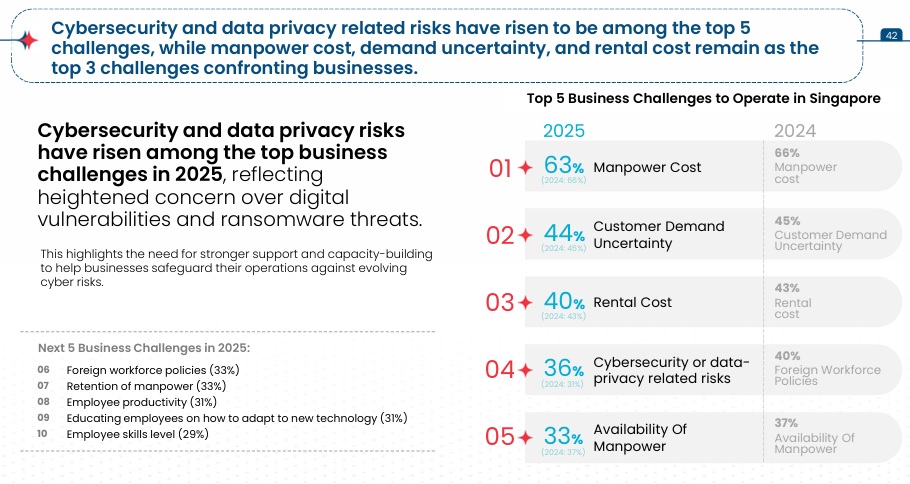
Cybersecurity and data privacy have emerged as major business concerns across industries. SMEs are particularly vulnerable, as many lack sufficient cybersecurity preparedness, creating significant business continuity risks in the event of a cyber incident.
Even organizations with limited resources can implement practical measures such as regular data backups, access control management, and employee phishing awareness training. Depending on their risk profile, companies may also consider cyber insurance and Software-as-a-Service (SaaS)-based security solutions.
As digitalization accelerates, cybersecurity risks will continue to grow regardless of company size. Establishing a baseline level of cyber resilience is increasingly becoming a prerequisite for maintaining competitiveness.
Expectations for Budget 2026
Businesses are looking to Singapore’s Budget 2026 for support in three key areas: cost relief, workforce development, and cash flow assistance.
For SMEs in particular, support measures that directly affect working capital and business continuity remain highly important. At the same time, there is strong interest in policies that strengthen long-term competitiveness, including incentives for digital transformation and international expansion.
Many organizations view government support not simply as short-term assistance, but as a means of building stronger and more resilient businesses for the future.
Summary
The survey highlights how companies across Singapore are navigating a combination of rising costs, uncertain demand, and ongoing talent challenges. While the current environment remains demanding, it also presents an opportunity for businesses to reassess their operating models and identify more sustainable paths to growth.
Organizations should begin by evaluating where practical improvements can be made within existing operations and cost structures. Even modest efficiency gains can create meaningful long-term benefits. Similarly, investments in digitalization, workforce development, and process improvement can strengthen future competitiveness when implemented consistently over time.
Periods of uncertainty can also create opportunities for low-risk experimentation, such as exploring new sales channels or conducting limited-scale tests in overseas markets. Rather than calling for immediate large-scale transformation, the survey findings suggest that companies should focus on steadily expanding their strategic options and building resilience at a manageable pace.
By taking measured, incremental steps, businesses can position themselves to uncover new opportunities, strengthen their capabilities, and achieve sustainable growth even amid ongoing economic uncertainty.
Feel free to contact us
MAY Planning provides advisory services in international expansion strategy, risk management, cybersecurity, and data privacy. We also support companies in overseas market entry, operational efficiency improvement, IT tool implementation, digital transformation (DX), and business process automation initiatives.
References:
1)SBF RESEARCH & REPORTS. (n.d.). SBF. https://www.sbf.org.sg/what-we-do/advocacy-policy/sbf-research-reports